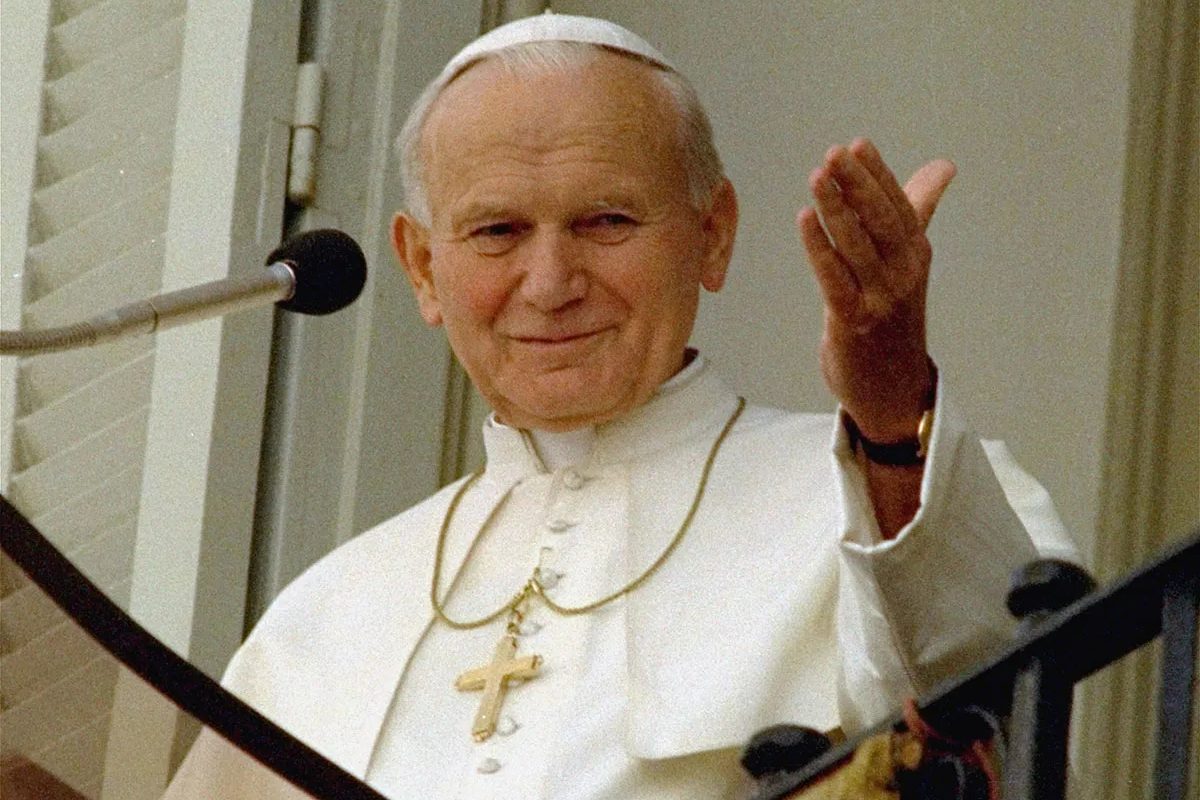
Today the Church remembers St. John Paul II - a pope who spent his pontificate insisting that every human life is unrepeatable, and that every person carries a mission no one else can fulfill.
In an age of mission statements and strategic plans, John Paul offered something different: not a formula, but a conviction. You are not an accident. You are not interchangeable. You have been called by name.
Here is what he taught.
"Called by Name"
From Christifideles Laici (1988), his apostolic exhortation on the lay faithful:
"God calls the individual in Jesus Christ, each one personally by name."
— Christifideles Laici, 28
This is not a metaphor. It is the heart of how John Paul understood vocation. Not a general summons to "do good" or "be holy," but a specific call - your name, spoken by God, attached to a task only you can do.
He continued:
"Each lay person is entrusted with a unique task which cannot be done by another."
— Christifideles Laici, 28
The word entrusted matters. A task entrusted is not optional. It is given into your care. And it cannot be delegated - because it was given to you.
In the same document, he quoted Gregory the Great:
"In the Holy Church, all are nourished by each one and each one is nourished by all."
— Gregory the Great, cited in Christifideles Laici, 28
Your uniqueness is not isolation. It is contribution. The Church needs what only you can give - and you need what only others can give. Communion and mission are bound together.
"More Than a Plan"
In 1985, John Paul wrote a letter to the youth of the world - Dilecti Amici ("Beloved Friends"). In it, he drew a distinction that cuts against how most of us think about purpose:
"'Vocation' means something more than 'plan.' A plan becomes a vocation when the factors that call a person shape it, and the vocation becomes a plan as the person draws it up."
— Dilecti Amici, 9
A plan is something you construct. A vocation is something you receive - and then live out through your choices.
He urged young people to bring the question directly to God:
"What must I do so that my life may have value, have meaning?"
— Dilecti Amici, 5
And he answered: meaning does not come from achievement or approval. It comes from discovering what has been entrusted to you - and becoming what you are called to be:
"You are called to be rooted in who you are in order to become that which you must become: for yourself, for other people, for God."
— Dilecti Amici, 9
This is not self-help. It is our anthropology. You are not a blank slate - you are a person created in the image of God, with a particular shape - and your task is to discover that shape and live it out.
"Unrepeatable"
John Paul's first encyclical, Redemptor Hominis (1979), set the tone for his entire pontificate. At its heart was a conviction about the human person:
"Each man in all the unrepeatable reality of what he is."
— Redemptor Hominis
Not "humanity" as an abstraction. Not "the human person" as a category. Each man. Each woman. In all the unrepeatable reality of what he or she is.
From this flowed his teaching on vocation:
"Man must discover his vocation, and discover it exactly!"
— John Paul II
Not approximately. Not vaguely. Exactly. Because your vocation is not a general direction - it is a specific path, fitted to the specific person you are.
Later in his pontificate, he would describe this as:
"A singular, unique, and unrepeatable grace."
— Redemptor Hominis
Grace - not burden. Gift - not demand. The call you carry is not a weight imposed on you. It is a grace given to you. The task is to receive it.
"A Seed Within"
Throughout his pontificate, John Paul returned to the image of vocation as something planted - a seed that grows.
"What is a vocation? It is an interior call of grace, which falls into the soul like a seed, to mature within it."
— Angelus message, December 14, 1980
The seed is already there. The work is not to manufacture a mission from scratch - it is to tend what has been planted. To let it mature. To let it bear fruit.
In a 1982 homily, he put it simply:
"Jesus has a specific task in life for each and every one of us. There is no one among us who does not have a divine vocation!"
— Homily, June 1, 1982
No one is exempt. No one is overlooked. The specific task exists - whether or not you have discovered it yet.
And in Familiaris Consortio, his 1981 exhortation on the family, he named the deepest layer of vocation:
"Love is the fundamental and innate vocation of every human being."
— Familiaris Consortio, 11
Before any particular calling - to marriage, to priesthood, to the diaconate, to religious life, to a specific work - there is this: you are made for love. That is the ground from which every other vocation grows.
"I Am With You"
Perhaps the most consoling thing John Paul said about vocation came in a 1995 homily:
"Every vocation is a deep personal experience of the truth of these words: 'I am with you.'"
— Homily, January 13, 1995
The call is not sent from a distance. It comes with presence. Whatever you are called to do, you are not called to do it alone.
The Discovery
Late in Christifideles Laici, John Paul named the purpose of all formation - all education, all spiritual growth, all discernment:
"The fundamental objective of the formation of the lay faithful is an ever clearer discovery of one's vocation."
— Christifideles Laici, 58
Not achievement. Not credentials. Not even holiness in the abstract. Discovery. An ever clearer discovery of the specific vocation that is yours.
And then this:
"This personal vocation and mission defines the dignity and responsibility of each member of the lay faithful."
— Christifideles Laici, 58
Your dignity is not earned, it is defined - and it is found deeply in the vocation you carry. And so is your responsibility. The two are inseparable.
For Today
John Paul II died in 2005 and was canonized in 2014. His teaching on personal vocation has only grown more urgent.
In a world that treats people as interchangeable - as labor units, as data points, as consumers - John Paul insisted: you are unrepeatable. In a culture that measures worth by productivity and influence, he insisted: your dignity comes from your calling, not your metrics.
And in a Church that sometimes reduces vocation to "clergy or not," he insisted: every baptized person has a vocation. Every life is a mission. Every person is called by name.
The question is not whether you have a vocation. You do.
The question is whether you will discover it - and live it.
St. John Paul II, pray for us.
Sources:
- Christifideles Laici (1988) - Vatican
- Dilecti Amici (1985) - EWTN
- Redemptor Hominis (1979) - Vatican
- Familiaris Consortio (1981) - Vatican
- Various homilies compiled at Paths of Love
Comments
Sign in to leave a comment.