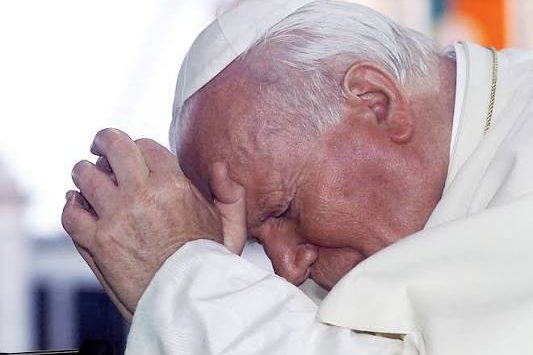
Thursday of the Twenty-Ninth Week in Ordinary Time — Memorial of Saint John Paul II | Ephesians 3:14-21 | Luke 12:49-53
Paul is on his knees.
Not figuratively. He says he kneels before the Father - an unusual posture for Jewish prayer, which was typically standing. Something in this prayer has brought him down. He is asking for something he knows is enormous: that the believers in Ephesus be strengthened in their inner selves, that Christ dwell in their hearts through faith, that they be rooted and grounded in love, that they comprehend with all the holy ones the breadth and length and height and depth of a love that surpasses knowledge.
And then his culmination: that you be filled with all the fullness of God.
This is not a modest prayer. Paul is asking that the infinite press itself into the finite, that the Creator take up residence not at the edges of a life but at the center of it. He is asking for everything.
The Gospel tells us what that looks like when it arrives.
"I have come to set the earth on fire, and how I wish it were already blazing."
Jesus is not speaking metaphorically about enthusiasm. The fire he describes is the same fire the prophets described - purifying, separating, consuming what cannot survive the presence of holiness. And he says immediately what that fire does in practice: it divides. Father against son. Mother against daughter. A household of five split three against two.
This is not Jesus celebrating conflict. He is describing the consequence of the fullness of God actually taking root in a person's life. When the fire is real - when Christ genuinely dwells in the heart, when a life is actually being conformed to the love that surpasses knowledge - it will not leave everything around it unchanged. It cannot.
Saint John Paul II, whose memorial the Church keeps today, spent his pontificate saying the same thing a different way. "Be not afraid," he told the world at the beginning. He was not minimizing the cost. He had lived under Nazi occupation and Soviet oppression; he knew what the fire consumed. He was saying: the fullness of God that Paul prays for, the fire that Jesus came to cast - these are not threats to the human person. They are what the human person was made for.
The divisions Jesus names are not the goal. They are the cost. The cost of the fire being actual rather than decorative, of faith being lived rather than performed, of a person genuinely filled with the fullness of God rather than a manageable version of religion that offends no one and changes nothing.
Paul prays for the fullness. Jesus tells us what the fullness costs.
The question both readings press together is the same: do we want the fire, or do we want the comfort of a faith that never quite blazes? The prayer Paul prays on his knees is a dangerous prayer. Fill them with all the fullness of God. He knows what he is asking. He has been on fire since Damascus, and it has cost him everything, and he is still on his knees asking God to do the same thing to the people he loves.
"How I wish it were already blazing."
So does he.
Comments
Sign in to leave a comment.