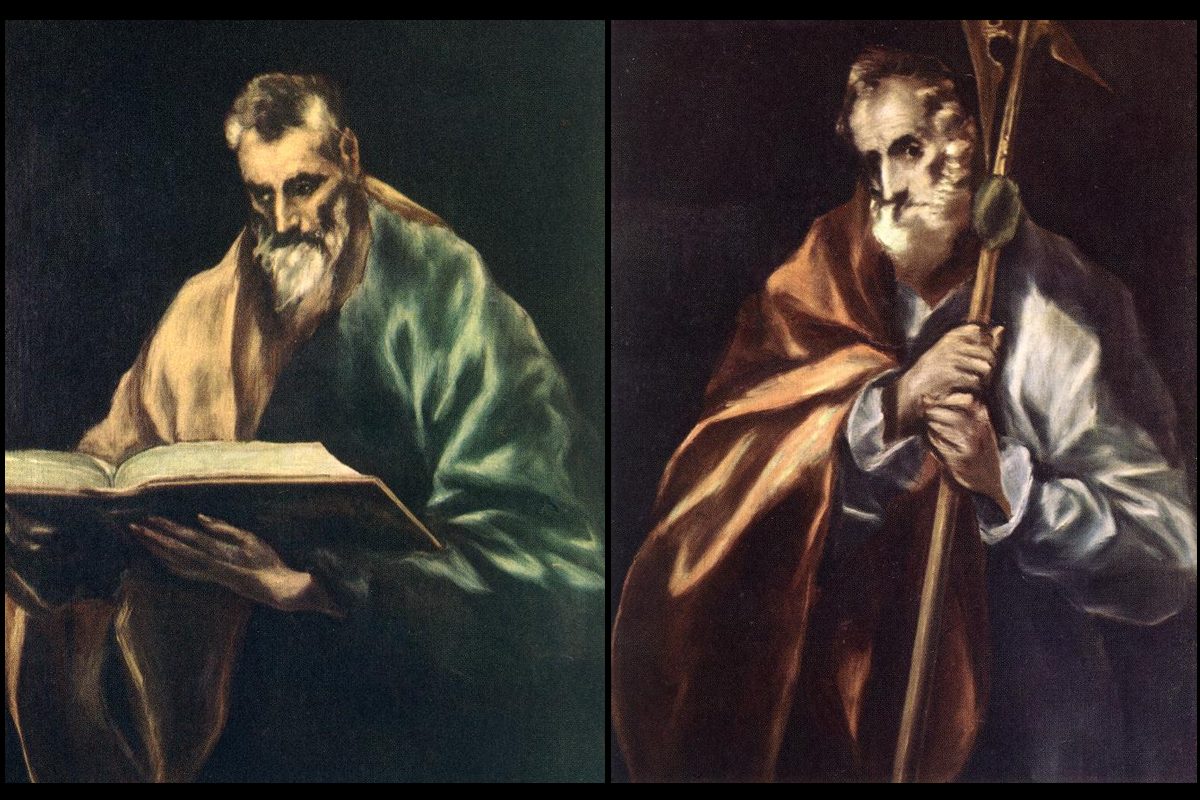
Feast of Saints Simon and Jude, Apostles | Ephesians 2:19-22 | Luke 6:12-16
Before Jesus named anyone an apostle, he went up a mountain and prayed through the night.
Luke is precise about this. "He spent the night in prayer to God." Not an hour. Not an evening prayer before sleep. The entire night - and then at daybreak he called his disciples and chose twelve from among them, whom he named apostles.
The easy reading is that he was deliberating. That the weight of the choice kept him in prayer the way a difficult decision keeps us awake. But that reading misses something essential about who is praying.
The Son of God, in his divinity, already knew these men. He knew Simon would deny him and become the rock. He knew Judas Iscariot would betray him and that Judas son of James would spend centuries being confused with him. He knew what each of them would do and fail to do and become. There was no information the night of prayer could add to what the eternal Son already held.
What the night of prayer was, then, is something different - and something more. In his humanity, Jesus entered into full and deliberate communion with the Father about what he was about to do. Not to learn it. Not to decide it. But to receive it as a human being receives something from God: in prayer, in the dark, with the whole of himself present to it. The choosing of the Twelve was not an administrative act to be executed. It was something the Son wanted to dwell in with the Father, in his human nature, before he carried it out at daybreak.
This is what the hypostatic union looks like in practice - not the Son bypassing his humanity to act from pure divine knowledge, but the Son living his divine knowledge through a fully human act of prayer.
The Church keeps the feast of Simon and Jude today - two of the Twelve, both named in that night's prayer, both easy to overlook. Simon the Zealot, whose political history we can only guess at. Jude son of James, who has spent most of Church history being confused with the traitor who shares his name - which is perhaps why he became the patron of lost causes, the saint of last resort for prayers that seem unlikely to be answered. Both of them were held in the Father's knowledge before the world began. Both of them were named at dawn after a night of prayer on a mountain.
Paul, writing to the Ephesians, says the Church is built on the foundation of the apostles and prophets, with Christ Jesus as the capstone. The foundation was laid in that night. Specific men, chosen by name, after a night in which the eternal Son brought his humanity fully into what he already knew.
"Their message goes out through all the earth."
It has. Because he prayed all night before he spoke their names.
Comments
Sign in to leave a comment.