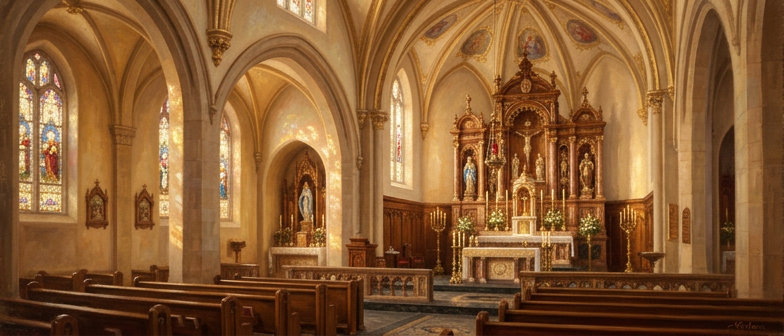
There's something I don't talk about often, and many of you don't know: Before I was a deacon, I was a music director and pianist-turned-organist
I served in this capacity for fourteen years. Organist, cantor, choir director at our home parish. I felt it when the liturgy was "working" - when something lifted - and I felt it when it wasn't.
Liturgy isn't an abstract preference for me. It's formational bedrock. It's how I came back to the faith, how I was shaped into the man I became, how I eventually heard the call to the diaconate. The liturgy formed me before I ever tried to form it.
The Ancient Formula
There's a phrase the Church has carried since at least the fifth century: Lex orandi, lex credendi. The law of prayer is the law of belief. How we pray shapes what we believe.
The full version extends it further: Lex orandi, lex credendi, lex vivendi. How we pray shapes what we believe shapes how we live.
This isn't a slogan. If you want to understand why Catholics believe what they believe - or why they've stopped believing it - look at how they pray. Look at the liturgy that formed them.
I was reminded of this a couple of weeks ago. My son Joseph and I have been going to the Oratory of St. Francis de Sales in St. Louis for Sunday Mass during my time off parish ministry. When we left Mass a couple of Sundays ago, he said something like, "What I like about Mass here is that if I took someone who didn't know what we believed, they would KNOW what we believed about the Eucharist from the way the Mass is celebrated."
Different Formations
I've been formed by different liturgical styles at different points in my life.
I grew up with the guitar Masses of the late 70s and early 80s - Carey Landry on my grandparents' record player, "Bloom Where You're Planted" in their living room. That music shaped something in me. I can't pretend it didn't. I was part of the guitar group. I took my ensemble to see the St. Louis Jesuits live in St. Louis on their reunion "tour".
As a music director, I worked within the conventions of the time - the hymn-sandwich, the contemporary repertoire, the assumptions about what "active participation" meant. I learned the craft inside that framework.
But the further I was formed by the liturgy and the Church - the more I read the documents, prayed the Office, studied the tradition - the more I began to desire what She truly desires. Not what a particular generation assumed or was told She wanted. What She has actually asked for, in Her own voice, across centuries.
What She Actually Asks For
This is the part that surprises people.
The Church's documents on liturgy - Sacrosanctum Concilium, the General Instruction of the Roman Missal, the instructions on sacred music - don't say what many American Catholics assume they say.
They ask for Gregorian chant to be given pride of place. They ask for the proper antiphons - the Church's own texts for the entrance, offertory, and communion - to be the primary option, with hymns as a permitted alternative. They ask for sacred silence as a form of active participation. They ask for Latin to be retained in the Roman Rite, with the faithful able to sing the parts of the Ordinary that belong to them.
This isn't nostalgia. This isn't liturgy wars. This is the Church's own stated preference, written plainly in her documents, and widely ignored in American parishes since the 1970s.
The "spirit of Vatican II" became a way to do what we wanted, and an entire economy rose around bringing (and selling) modern music into our liturgy. The letter of Vatican II asks for something different - something more reverent, more rooted, more connected to the tradition that preceded it.
What This Sabbatical Is Surfacing
I'm in the middle of a sabbatical from active parish ministry. I've written about what it's teaching me - about saying no, about focus, about seeking first the Kingdom.
But there's another thread I haven't named publicly: the sabbatical is clarifying how much liturgy shapes everything else.
My prayer. My sense of the sacred. My ability to serve joyfully. My peace in the sanctuary. It's not peripheral. It's central.
When the liturgy lifts - when it's celebrated with reverence, when the music serves the text, when the silence is allowed to breathe - something in me opens. When it doesn't, something closes. I've learned to trust that response. It's not preference. It's formation working backward, telling me what it needs to keep working forward.
Not a Weapon
I want to be careful here.
I'm not interested in liturgy wars. I'm not interested in scoring points or picking sides. The people who shape the liturgies that frustrate me love their parishes. They give decades of service. They do their faithful best inside a moment that changed underneath them, and often they haven't been taught what the church desires - and sometimes their pastors haven't either.
And I'm not claiming to have all the answers. I'm still discerning what my own service should look like in the next season - and that discernment includes hard questions about liturgy that I don't yet know how to resolve.
But I know this: lex orandi, lex credendi, lex vivendi. How we pray shapes what we believe shapes how we live.
If we want Catholics who believe deeply and live faithfully, we need liturgy that forms them for that. Reverent. Beautiful. Rooted in the tradition. Celebrated as the Church actually asks.
Archbishop Cordileone calls it "a renaissance of excellence in Catholic liturgy." I think that's exactly right. Not a return to some imagined golden age. A recovery of seriousness, beauty, and reverence - because the liturgy forms us before we ever try to form it.
And what it forms in us matters for everything else.
Comments
Sign in to leave a comment.