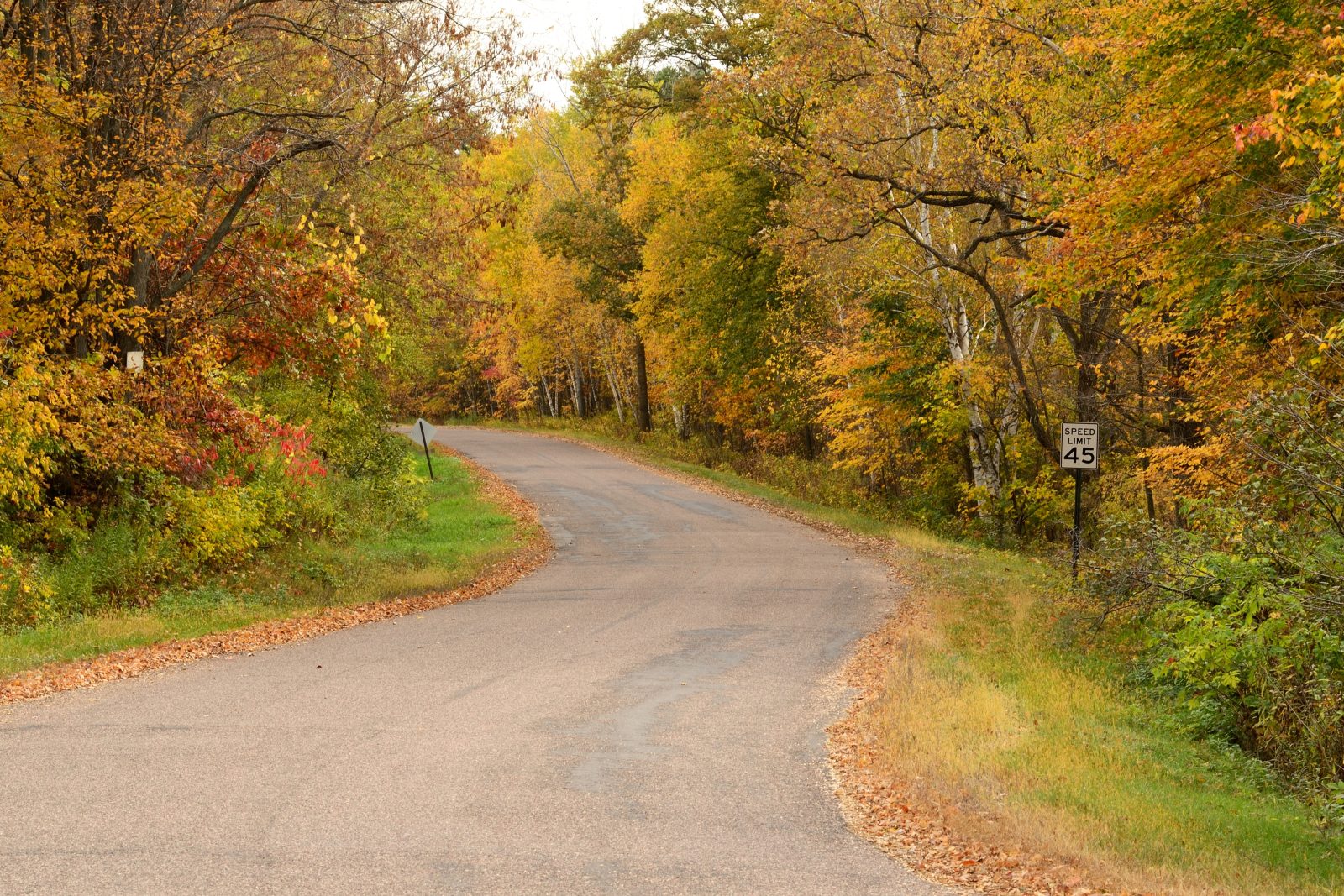
The leaves came fast this year.
Two weeks ago the trees were still holding their color. Last week they were really just starting to turn. We drove to Quincy along the Great River Road and back this Sunday, and in some places the leaves were already starting to thin. You can see through the trees now to what was hidden all summer.
November does this every year, but it still catches me with the speed and relentlessness of it. One day the horizon is a carpet of color; the next, it's bare branches and gray sky.
The Church, in her wisdom, times her liturgy to match. We've just passed All Saints and All Souls. The readings at Mass have pivoted toward endings - the last things, the final judgment, the question of what remains when everything else falls away.
It's not subtle. The Church wants us to think about death.
A Saturday with the Dying
This past Saturday, I spent a full day with my brother deacons at a formation conference. The topic was pastoral care of the dying.
Our presenter, Msgr. Richard Chiola, walked us through the stages of dying, the practical realities of hospice care, the tasks of mourning, the Church's teaching on end-of-life decisions - and then, in the afternoon, the harder work: how to actually be present to someone who is dying, and to the family members who are watching them go.
It was one of the best formation days I can remember. Not because the content was easy - it wasn't. Because it was real. Because it addressed something every one of us will face, either in ministry or in our own families, and probably both.
I want to share three things that stayed with me.
1. You Are Not Alone - and You Never Will Be
The deepest fear of the dying, we were told, is not pain. It's not even death itself. It's abandonment. The fear of being left alone.
This is why the Church has always emphasized presence at the end of life. The Viaticum - the last Holy Communion - is given specifically so that Christ himself accompanies the dying person on their final journey. The word means "provision for the journey." You don't travel alone.
Henri Nouwen wrote extensively about this. In Our Greatest Gift, he reflects on his own mother's death and what it taught him about accompaniment:
"Dying is the most general human event, something we all have to do. But do we do it well? Is our death more than an unavoidable fate that we simply try to keep from happening as long as possible? Or can it be for us and others the final, most fulfilling gift?"
The gift, Nouwen says, is presence. Not words. Not solutions. Presence.
Fr. Myles Sheehan, a Jesuit geriatrician who spent years with the dying, puts it bluntly: "The key players, however, are the person who is dying, those who love him and God." Everyone else - chaplains, doctors, nurses - exists to support that central relationship.
When I walk into a room with a dying person and their family, I often feel inadequate. What do I say? What can I possibly offer? Saturday's formation reminded me: I'm not there to fix anything. I'm there so they know they're not alone. I'm there to hold space for what is actually happening. And in that holding, Christ is present.
2. We Die the Way We Live
This one landed hard.
The formation materials quoted The Imitation of Christ: "Every action of yours, every thought, should be those of one who expects to die before the day is out. Death would have no great terrors for you if you had a quiet conscience.... Then why not keep clear of sin instead of running away from death? If you are not fit to face death today, it's very unlikely you will be tomorrow."
Thomas à Kempis wrote that in the 15th century. It remains uncomfortably true.
The pattern of your life becomes the pattern of your death. If you've spent decades cultivating gratitude, you will likely die grateful. If you've spent decades nursing resentment, that resentment doesn't magically dissolve in the final hours. The habits you build in ordinary time are the habits you'll have access to at the end.
Romano Guardini, the great Catholic philosopher, wrote in The Last Things about how death reveals what was always true about a person:
"Death is the moment of truth. It strips away all pretense and reveals what a man truly is."
This isn't meant to terrify - though it might. It's meant to clarify. Every ordinary day is preparation. Every small choice about patience or impatience, generosity or selfishness, forgiveness or grudge-holding - these are rehearsals. The performance, when it comes, will draw on what you've practiced.
Cardinal Joseph Bernardin understood this. In The Gift of Peace, written as he was dying of pancreatic cancer, he reflected on how his years of prayer and ministry had prepared him for this final chapter:
"I have come to realize how much time I wasted worrying about the past or fretting about the future. Now I try to focus on the present moment - where God is."
He died the way he had lived: in surrender, in peace, in prayer. That wasn't an accident. It was the fruit of a lifetime.
3. The Bedside Is Also for Me
This is the insight that surprised me most, and it's the one I shared at the end of the day when Msgr. Chiola asked each of us to share our greatest takeaway - to internalize it for ourselves.
I've always thought of bedside visits as something I do for the dying person and their family. I show up. I pray. I try to be helpful. And then I leave, relieved to return to the land of the living.
But Saturday's formation reframed it. The chaplain or deacon at the bedside is not just a giver. They are also a receiver. The encounter with death is an encounter with reality - with what matters, with what doesn't, with the God who meets us at the threshold.
Fr. Sheehan writes: "Chaplains are aware that family members and significant others are already beginning to grieve. The quality of the death they witness can hinder or help in the grieving process."
But there's something more. The dying person, by their very vulnerability, becomes a teacher. They are doing something I have not yet done. They are facing something I will one day face. And if I'm paying attention - if I'm not just going through the motions - I can learn from them.
Nouwen again: "We must allow the dying to teach us how to die."
This shifts everything. I'm not just there to dispense sacraments and prayers. I'm there to receive something - a glimpse of what matters, a reminder of my own mortality, an invitation to live more truly today because I've been near someone who is leaving today behind.
The discomfort I feel walking into that room? That's not a bug. That's the work. The discomfort is the growing edge. The resistance is where the growth is.
The Four Last Things
Catholic tradition speaks of the "four last things": death, judgment, heaven, and hell. November is the month the Church invites us to contemplate them - not morbidly, but honestly.
Peter Kreeft, the Catholic philosopher, writes in his book Everything You Ever Wanted to Know About Heaven:
"The fear of death is natural, but the denial of death is not. We are the only civilization in history that has tried to deny death, to make it invisible, to ban it from polite conversation."
He's right. We don't talk about death. We don't prepare for death. We pretend it won't happen to us - or at least not anytime soon.
The falling leaves tell a different story. So does the Church's liturgy. So does the face of the person in the hospice bed.
November says: this is real. This is coming. And the question is not whether you will die, but how you will live in light of it.
The Prayer of Commendation
One of the prayers from the formation day (and from the book of prayers we pray at the bedside) stays with me. It's prayed as death approaches:
"Go forth, Christian soul, from this world, in the name of God the almighty Father, who created you, in the name of Jesus Christ, Son of the living God, who suffered for you, in the name of the Holy Spirit, who was poured out upon you, go forth, faithful Christian.
May you live in peace this day, may your home be with God in Zion, with Mary, the Virgin Mother of God, with Joseph, and all the Angels and Saints."
It's a sending, a commissioning. An acknowledgment that the one who is dying is not ending, but going - and not going alone.
I don't know when I'll pray that prayer next. But I know that somewhere in the room, someone will be watching how I hold the moment. Just as I've watched others hold it before me.
Back to the Leaves
By Thanksgiving the trees will be bare.
Every year I watch this happen, and every year it catches me off guard. The speed. The thoroughness. The way the world thins out to reveal what was hidden.
But the revelation is the point. November strips away the foliage and shows us the bones. The liturgy does the same. It asks: what's underneath all the busyness, all the distraction, all the noise?
A life. A death. A judgment. And - please God - a mercy.
Cardinal Bernardin, near the end, said: "A dying person does not have time for the trivial."
Neither, really, does anyone else. We just pretend we do.
This Sunday evening I'll be teaching "The Four Last Things" to our high school youth group. Death, judgment, heaven, hell. It's not the lesson most youth ministers would pick for a Sunday night. But November is the time. And if we don't talk about it honestly - if we keep pretending the leaves don't fall - we're not doing them any favors.
The trees are thinning. The sky is gray. And the Church, once again, invites us to think about death - not to make us morbid, but to make us real.
Eternal rest grant unto them, O Lord, and let perpetual light shine upon them.
Have you had an experience at a bedside that changed how you think about death - or about life? I'd be curious to hear. Reply or leave a comment.
Sources and Further Reading:
- Henri Nouwen, Our Greatest Gift: A Meditation on Dying and Caring (HarperOne, 1994)
- Cardinal Joseph Bernardin, The Gift of Peace: Personal Reflections (Loyola Press, 1997)
- Fr. Myles Sheehan, SJ, "On Dying Well" - America Magazine (2000)
- Peter Kreeft, Everything You Ever Wanted to Know About Heaven (Ignatius Press, 1990)
- Romano Guardini, The Last Things (University of Notre Dame Press, 1954)
- Thomas à Kempis, The Imitation of Christ (15th century)
- Linda F. Piotrowski, "The Chaplain's Role as Catalyst for 'Good Death'" - Health Progress (2017)
Comments
Sign in to leave a comment.