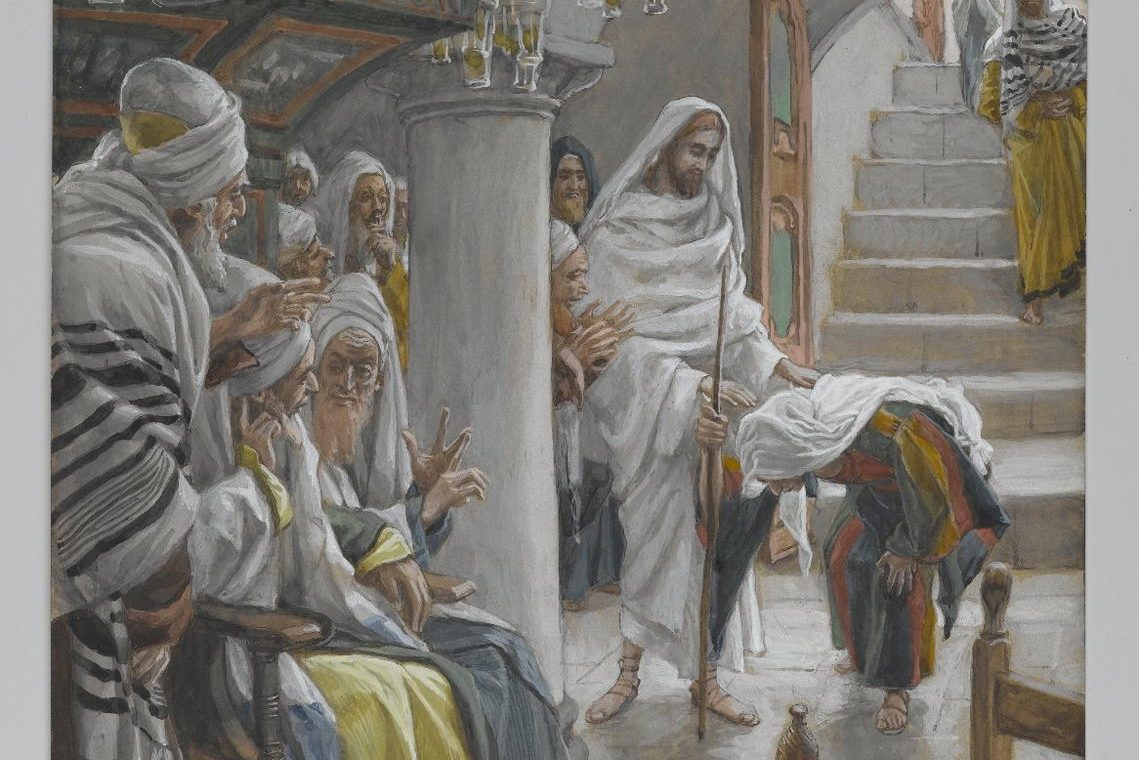
Monday of the Thirtieth Week in Ordinary Time | Ephesians 4:32-5:8 | Luke 13:10-17
She is bent over, unable to stand upright at all. A spirit has held her this way, and it has been eighteen years.
Luke does not tell us her name. He tells us the duration - eighteen years - which is long enough for the weight of an affliction to settle into a life, long enough for what has been done to you to start feeling like simply who you are.
Jesus sees her, calls her over, and says: "Woman, you are set free of your infirmity." He lays his hands on her, and immediately she stands up straight and glorifies God.
The synagogue leaders' objection is immediate: there are six days for healing. Why the sabbath? Jesus does not argue with him about sabbath law. He points to the animals. You untie your ox and lead it to water on the sabbath. You would do that without a second thought. This woman - a daughter of Abraham, bound by Satan for eighteen years - should she not be unbound on the sabbath, of all days?
The sabbath is the day of rest, yes. But it is also the day that points forward - to the liberation that is coming, to the restoration of all things, to the day when everything bent will stand upright. If there is a day to unbind a daughter of Abraham, it is this day.
Paul, writing to the Ephesians, puts it in terms of light and darkness. "You were once darkness, but now you are light in the Lord. Live as children of light." He is not speaking metaphorically about good moods and bad moods. He is naming a change in the nature of things. Before: darkness. Now: light. The transformation is as real as a woman who stood bent for eighteen years and now stands upright.
The behaviors he lists - kindness, compassion, forgiveness, the giving up of immorality and impurity and empty talk - are not a program for self-improvement. They are descriptions of what children of light look like. A person who has been genuinely unbound, who has been freed from what kept them bent, begins to stand differently. Begins to treat people differently. Begins to speak differently. The posture changes because something in the person has changed.
The crowd rejoices at the woman's healing. The synagogue leader is humiliated. The difference between them is not that one is more religious than the other. It is that one can see what has happened and one cannot. The leader sees a violation. The crowd sees a daughter of Abraham standing up straight for the first time in eighteen years.
Paul's question is the same one Jesus is asking the crowd: do you see what has happened to you? You were bent. You were darkness. You were bound. And you were freed - not on a random day but on the day that was made for it.
Live as though that is true.
Comments
Sign in to leave a comment.