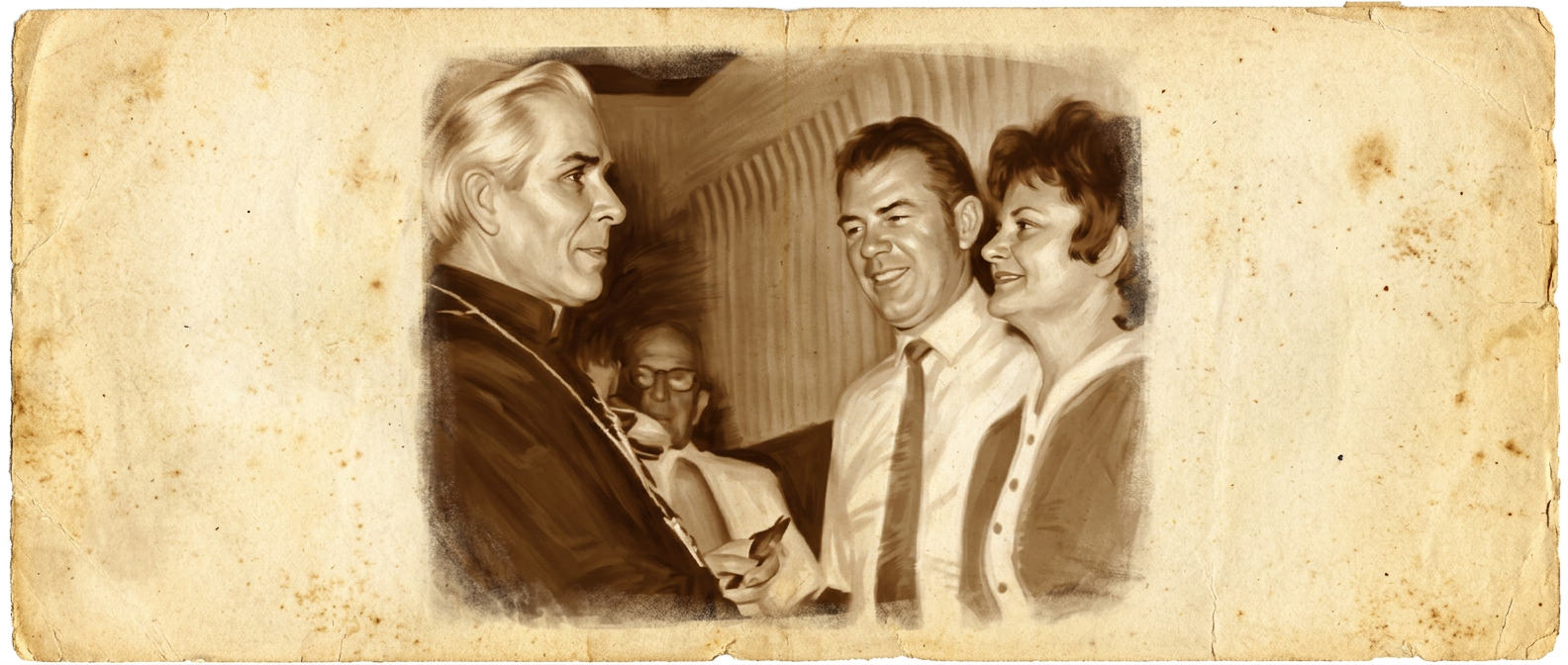
In October 1972, a journalist from Granite City drove to Warrenton, Missouri to interview a bishop.
The journalist was Francis Rees - a Navy veteran, a father of thirteen, a graduate of St. Louis University's philosophy program, and a lifelong student of philosophy and theology. He worked as general manager of the Suburban Journals and later the Troy Times Tribune. He read Chesterton and Lewis and Maritain and Aquinas. He played the saxophone and loved jazz.
The bishop was Fulton J. Sheen.
Sheen had come to the Passionist Retreat House of Our Lady to lead a retreat for priests of the archdiocese. There was no fanfare. Father Luke Connolly brought him in by car. Francis Rees brought a camera crew, his wife Louise, and a head full of questions about eternity, abortion, war, and the kind of man the age needs.
The result was "A Visit With Bishop Sheen," published in the St. Charles Journal on October 16, 1972.
I have a copy of that article because Francis Rees's daughter, Marylou Lyerla, is a friend and fellow parishioner at St. Elizabeth in Granite City. Marylou has told me stories about her father over the years - the books he read, the way he thought, the conversations he would have had. She thinks we would have been kindred spirits. After reading this article, I think she's right.
And the timing feels providential. On September 24, 2026 - just weeks from now - Archbishop Fulton J. Sheen will be beatified at the Dome at America's Center in St. Louis. Cardinal Luis Tagle will preside on behalf of Pope Leo XIV. The man Francis Rees interviewed in a small office in Warrenton will become Blessed Fulton Sheen.
What follows is the cleaned-up text of that 1972 article, along with a few reflections on what it means to read it now.
1. A Philosopher in the Parish
Francis Rees was not a professional philosopher. He was a newspaper man. But he had a bachelor's degree in philosophy from SLU, and his obituary describes him as "a lifelong student of Philosophy and Theology."
You can see it in the article. He doesn't ask Sheen about television ratings or celebrity conversions. He asks about the nature of time and eternity. He quotes T.S. Eliot. He brings up Maritain's proposal for a world council of wise men. He asks whether Thomas Aquinas will return in stature to the Catholic Church.
This is a man who read deeply and thought seriously about the faith - not as a career, but as a vocation. The intellectual life as a way of being Catholic.
Every parish has people like this, if you know where to look. They're not always the ones leading ministries or sitting on councils. Sometimes they're the ones in the back pew with a well-worn copy of something you've never heard of, waiting for someone to ask them a question.
Francis Rees was one of these. And when he got the chance to sit with Fulton Sheen, he was ready.
2. "Never Have I Been So Listened To"
There's a moment in the article that stopped me.
After the interview, as Sheen was about to leave for his talk, Francis Rees writes: "I thought, 'Never have I been so listened to.'"
This is Fulton Sheen - the greatest Catholic orator of the twentieth century, a man whose television ratings rivaled Milton Berle, a bishop who had converted thousands. And what Francis Rees remembers most is that Sheen listened.
There's a lesson here for anyone in ministry. The gift of attention is the gift of presence. To be fully listened to is to be made real. Sheen's fame came from his speaking, but his holiness showed in his listening.
3. The Man the Age Needs
Francis Rees asked Sheen: "What kind of man does this age need? Who is he? Where is he?"
Sheen's answer is worth reading slowly:
"He may be at the very top. Or he may be at the very bottom. If he comes from the bottom he will undoubtedly be a Saint. If he comes from the top he may be the leader of a government. He will be a man who enters into his time, but who is not caught up by his time. Those who are caught up in their time are gone when that time is gone. A man such as Augustine was a man in touch with his time but not a man caught up in his time. This is the man we need."
A man who enters into his time, but is not caught up by his time.
This is the challenge of every generation - to be present to the moment without being captured by it. To engage the culture without being absorbed by it. To speak the language of the age without losing the grammar of eternity.
Sheen himself was this kind of man. He used television when television was new. He engaged psychoanalysis and communism and the anxieties of the atomic age. But he never let the medium become the message. The content was always Christ crucified.
The men and women the Church needs now are the same: present to the moment, but not prisoners of it.
4. Christ Was Not a Social Reformer
At the end of the article, Francis Rees summarizes Sheen's retreat talk to the 200 priests:
"The world today has denied sin; denied guilt. There is no sin; there is only sickness... Without the shedding of blood there is no remission of sin. For fallen man Christ brought his blood into the world. And that is what it is all about."
Then this line, which Rees attributes to Sheen's implicit message: "Christ was not a social reformer; he was a victim."
And then the reaction of one of the priests afterward: "I had never thought of myself as a victim."
This is the heart of priestly - and diaconal - identity. We are configured to Christ the Servant, the one who poured himself out, the one who took up the cup in Gethsemane and said not my will, but yours. The ordained minister is not primarily a manager or a program director or a social worker. He is a victim in the theological sense - one who offers himself alongside the offering of Christ.
Francis Rees's closing line haunts me: "If those 200 or so priests here at The Passionist Retreat House of Our Lady make that discovery a whole world might change."
What would change if we made that discovery?
5. Beatification in Our Backyard
In ten weeks, Fulton Sheen will be beatified in St. Louis.
The man who sat in that small office in Warrenton, who listened so intently to a philosophy-loving journalist from Granite City, who told 200 priests that they were called to be victims - that man will be declared Blessed by the universal Church.
And Francis Rees, who wrote this article in 1972, whose funeral Mass was celebrated at St. Elizabeth in Granite City in 2006, whose daughter still sits in the pews where I serve - he saw something that day. He captured something. A conversation between a local Catholic intellectual and the greatest communicator the American Church has ever produced.
I never met Francis Rees. But Marylou is right: I think we would have been kindred spirits.
And I'm grateful he left this behind.
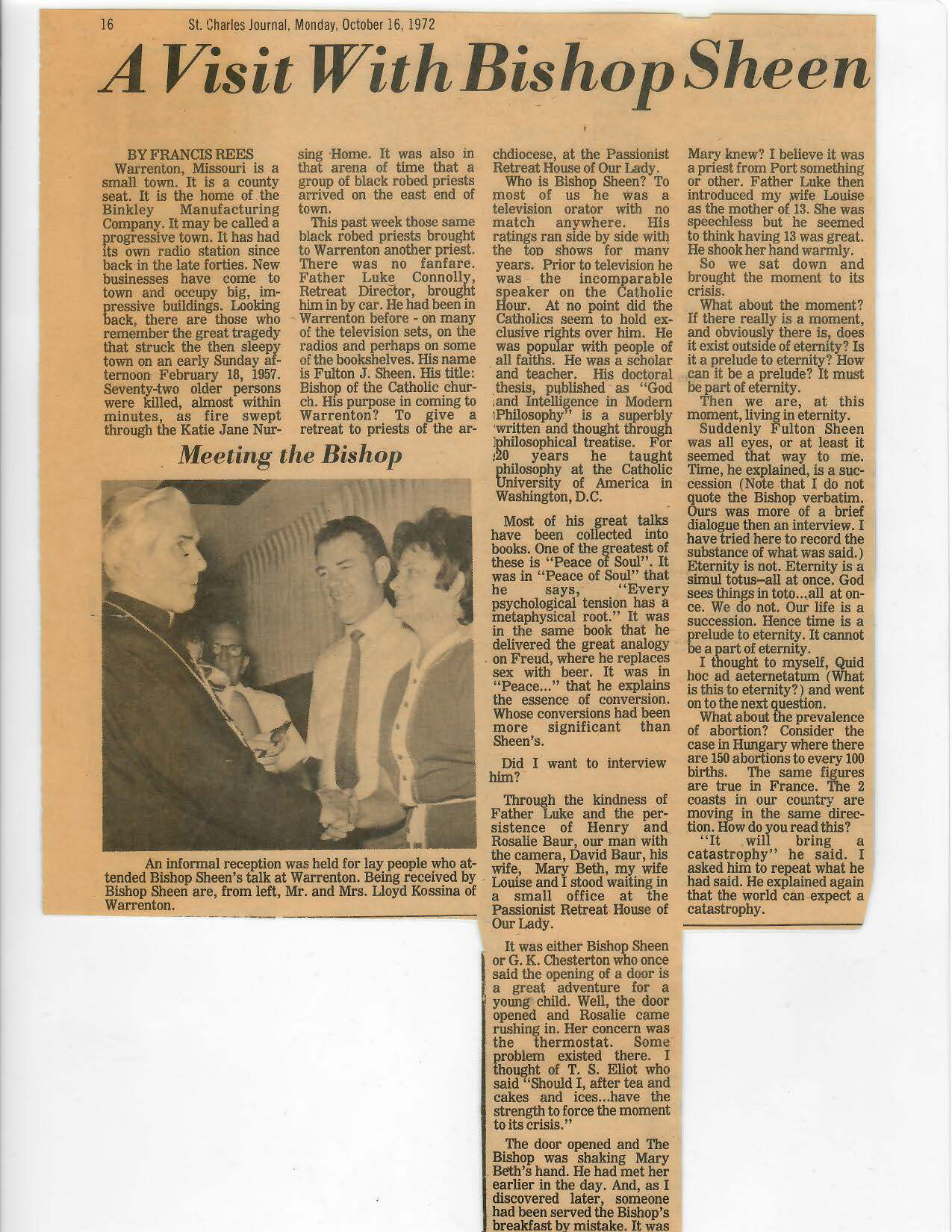
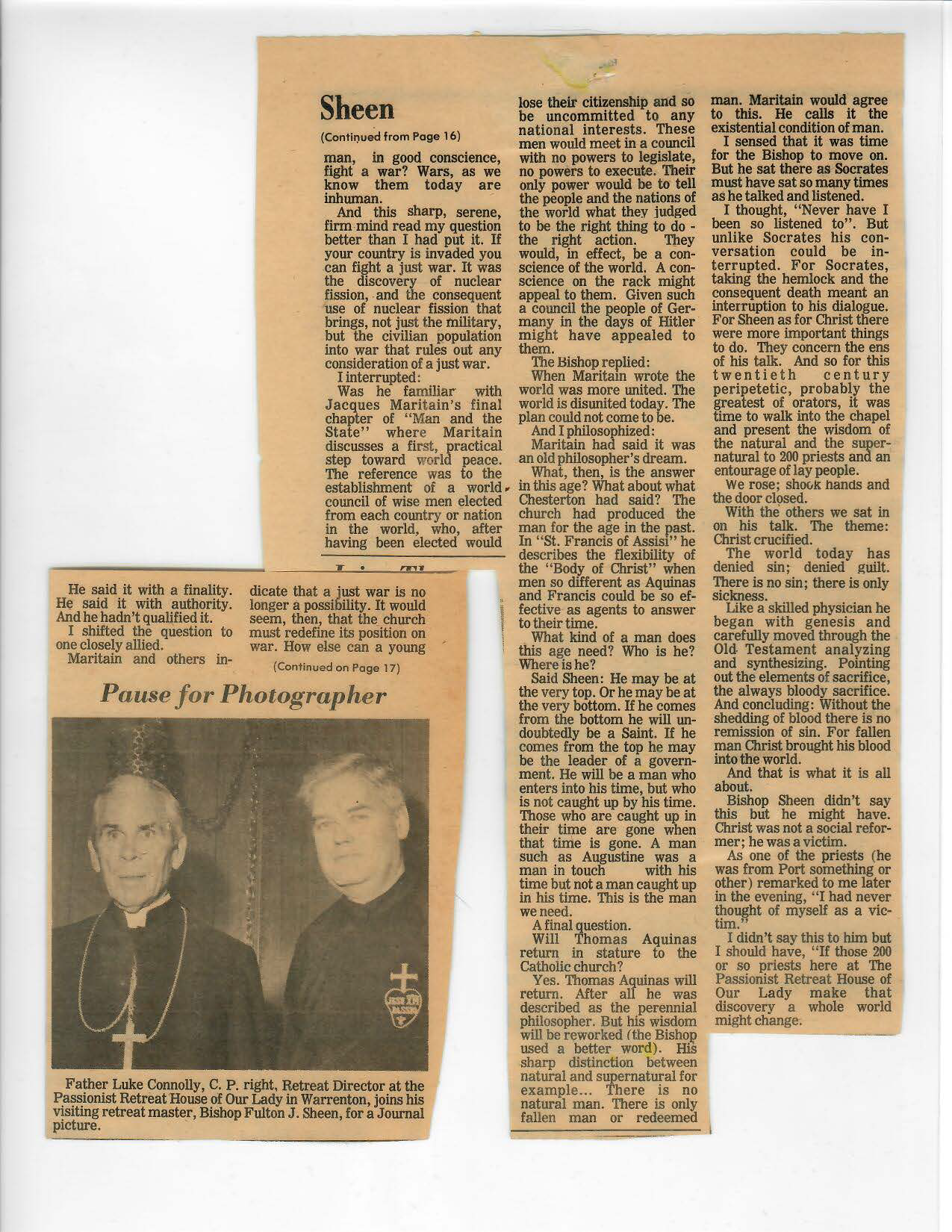
Below is the full text of Francis Rees's 1972 article, along with the original newspaper images.
A Visit With Bishop Sheen
St. Charles Journal, Monday, October 16, 1972
By Francis Rees
Warrenton, Missouri is a small town. It is a county seat. It is the home of the Binkley Manufacturing Company. It may be called a progressive town. It has had its own radio station since back in the late forties. New businesses have come to town and occupy big, impressive buildings.
Looking back, there are those who remember the great tragedy that struck the then sleepy town on an early Sunday afternoon February 18, 1957. Seventy-two older persons were killed, almost within minutes, as fire swept through the Katie Jane Nursing Home.
It was also in that arena of time that a group of black robed priests arrived on the east end of town.
This past week those same black robed priests brought to Warrenton another priest. There was no fanfare. Father Luke Connolly, Retreat Director, brought him in by car. He had been in Warrenton before - on many of the television sets, on the radios and perhaps on some of the bookshelves. His name is Fulton J. Sheen. His title: Bishop of the Catholic Church. His purpose in coming to Warrenton? To give a retreat to priests of the archdiocese, at the Passionist Retreat House of Our Lady.
Meeting the Bishop
Who is Bishop Sheen? To most of us he was a television orator with no match anywhere. His ratings ran side by side with the top shows for many years. Prior to television he was the incomparable speaker on the Catholic Hour. At no point did the Catholics seem to hold exclusive rights over him. He was popular with people of all faiths. He was a scholar and teacher. His doctoral thesis, published as "God and Intelligence in Modern Philosophy" is a superbly written and thought through philosophical treatise. For 20 years he taught philosophy at the Catholic University of America in Washington, D.C.
Most of his great talks have been collected into books. One of the greatest of these is "Peace of Soul." It was in "Peace of Soul" that he says, "Every psychological tension has a metaphysical root." It was in the same book that he delivered the great analogy on Freud, where he replaces sex with beer. It was in "Peace..." that he explains the essence of conversion. Whose conversions had been more significant than Sheen's.
Did I want to interview him?
Through the kindness of Father Luke and the persistence of Henry and Rosalie Baur, our man with the camera, David Baur, his wife, Mary Beth, my wife Louise and I stood waiting in a small office at the Passionist Retreat House of Our Lady.
It was either Bishop Sheen or G. K. Chesterton who once said the opening of a door is a great adventure for a young child. Well, the door opened and Rosalie came rushing in. Her concern was the thermostat. Some problem existed there. I thought of T. S. Eliot who said "Should I, after tea and cakes and ices... have the strength to force the moment to its crisis."
The door opened and The Bishop was shaking Mary Beth's hand. He had met her earlier in the day. And, as I discovered later, someone had been served the Bishop's breakfast by mistake. It was Mary - knew? I believe it was a priest from Port something or other. Father Luke then introduced my wife Louise as the mother of 13. She was speechless but he seemed to think having 13 was great. He shook her hand warmly.
So we sat down and brought the moment to its crisis.
On Time and Eternity
What about the moment? If there really is a moment, and obviously there is, does it exist outside of eternity? Is it a prelude to eternity? How can it be a prelude? It must be part of eternity.
Then we are, at this moment, living in eternity.
Suddenly Fulton Sheen was all eyes, or at least it seemed that way to me. Time, he explained, is a succession. (Note that I do not quote the Bishop verbatim. Ours was more of a brief dialogue than an interview. I have tried here to record the substance of what was said.) Eternity is not. Eternity is a simul totus - all at once. God sees things in toto... all at once. We do not. Our life is a succession. Hence time is a prelude to eternity. It cannot be a part of eternity.
I thought to myself, Quid hoc ad aeternetatum (What is this to eternity?) and went on to the next question.
On Abortion and Catastrophe
What about the prevalence of abortion? Consider the case in Hungary where there are 150 abortions to every 100 births. The same figures are true in France. The two coasts in our country are moving in the same direction. How do you read this?
"It will bring a catastrophe," he said. I asked him to repeat what he had said. He explained again that the world can expect a catastrophe.
He said it with a finality. He said it with authority. And he hadn't qualified it.
On War and Just War
I shifted the question to one closely allied. Maritain and others indicate that a just war is no longer a possibility. It would seem, then, that the church must redefine its position on war. How else can a young man, in good conscience, fight a war? Wars, as we know them today are inhuman.
And this sharp, serene, firm mind read my question better than I had put it. If your country is invaded you can fight a just war. It was the discovery of nuclear fission, and the consequent use of nuclear fission that brings, not just the military, but the civilian population into war that rules out any consideration of a just war.
I interrupted: Was he familiar with Jacques Maritain's final chapter of "Man and the State" where Maritain discusses a first, practical step toward world peace. The reference was to the establishment of a world council of wise men elected from each country or nation in the world, who, after having been elected would lose their citizenship and so be uncommitted to any national interests. These men would meet in a council with no powers to legislate, no powers to execute. Their only power would be to tell the people and the nations of the world what they judged to be the right thing to do - the right action. They would, in effect, be a conscience of the world. A conscience on the rack might appeal to them. Given such a council the people of Germany in the days of Hitler might have appealed to them.
The Bishop replied: When Maritain wrote the world was more united. The world is disunited today. The plan could not come to be.
And I philosophized: Maritain had said it was an old philosopher's dream.
The Man This Age Needs
What, then, is the answer in this age? What about what Chesterton had said? The church had produced the man for the age in the past. In "St. Francis of Assisi" he describes the flexibility of the "Body of Christ" when men so different as Aquinas and Francis could be so effective as agents to answer to their time.
What kind of a man does this age need? Who is he? Where is he?
Said Sheen: He may be at the very top. Or he may be at the very bottom. If he comes from the bottom he will undoubtedly be a Saint. If he comes from the top he may be the leader of a government. He will be a man who enters into his time, but who is not caught up by his time. Those who are caught up in their time are gone when that time is gone. A man such as Augustine was a man in touch with his time but not a man caught up in his time. This is the man we need.
On Thomas Aquinas
A final question. Will Thomas Aquinas return in stature to the Catholic Church?
Yes. Thomas Aquinas will return. After all he was described as the perennial philosopher. But his wisdom will be reworked. His sharp distinction between natural and supernatural for example... There is no natural man. There is only fallen man or redeemed man. Maritain would agree to this. He calls it the existential condition of man.
The Talk
I sensed that it was time for the Bishop to move on. But he sat there as Socrates must have sat so many times as he talked and listened.
I thought, "Never have I been so listened to." But unlike Socrates his conversation could be interrupted. For Socrates, taking the hemlock and the consequent death meant an interruption to his dialogue. For Sheen as for Christ there were more important things to do. They concern the end of his talk. And so for this twentieth century peripatetic, probably the greatest of orators, it was time to walk into the chapel and present the wisdom of the natural and the supernatural to 200 priests and an entourage of lay people.
We rose; shook hands and the door closed.
With the others we sat in on his talk. The theme: Christ crucified.
The world today has denied sin; denied guilt. There is no sin; there is only sickness.
Like a skilled physician he began with genesis and carefully moved through the Old Testament analyzing and synthesizing. Pointing out the elements of sacrifice, the always bloody sacrifice. And concluding: Without the shedding of blood there is no remission of sin. For fallen man Christ brought his blood into the world.
And that is what it is all about.
Bishop Sheen didn't say this but he might have: Christ was not a social reformer; he was a victim.
As one of the priests (he was from Port something or other) remarked to me later in the evening, "I had never thought of myself as a victim."
I didn't say this to him but I should have: "If those 200 or so priests here at The Passionist Retreat House of Our Lady make that discovery a whole world might change."
[Photo caption: An informal reception was held for lay people who attended Bishop Sheen's talk at Warrenton. Being received by Bishop Sheen are, from left, Mr. and Mrs. Lloyd Kossina of Warrenton.]
[Photo caption: Father Luke Connolly, C.P., right, Retreat Director at the Passionist Retreat House of Our Lady, joins his visiting retreat master, Bishop Fulton J. Sheen, for a Journal picture.]
Comments
Sign in to leave a comment.