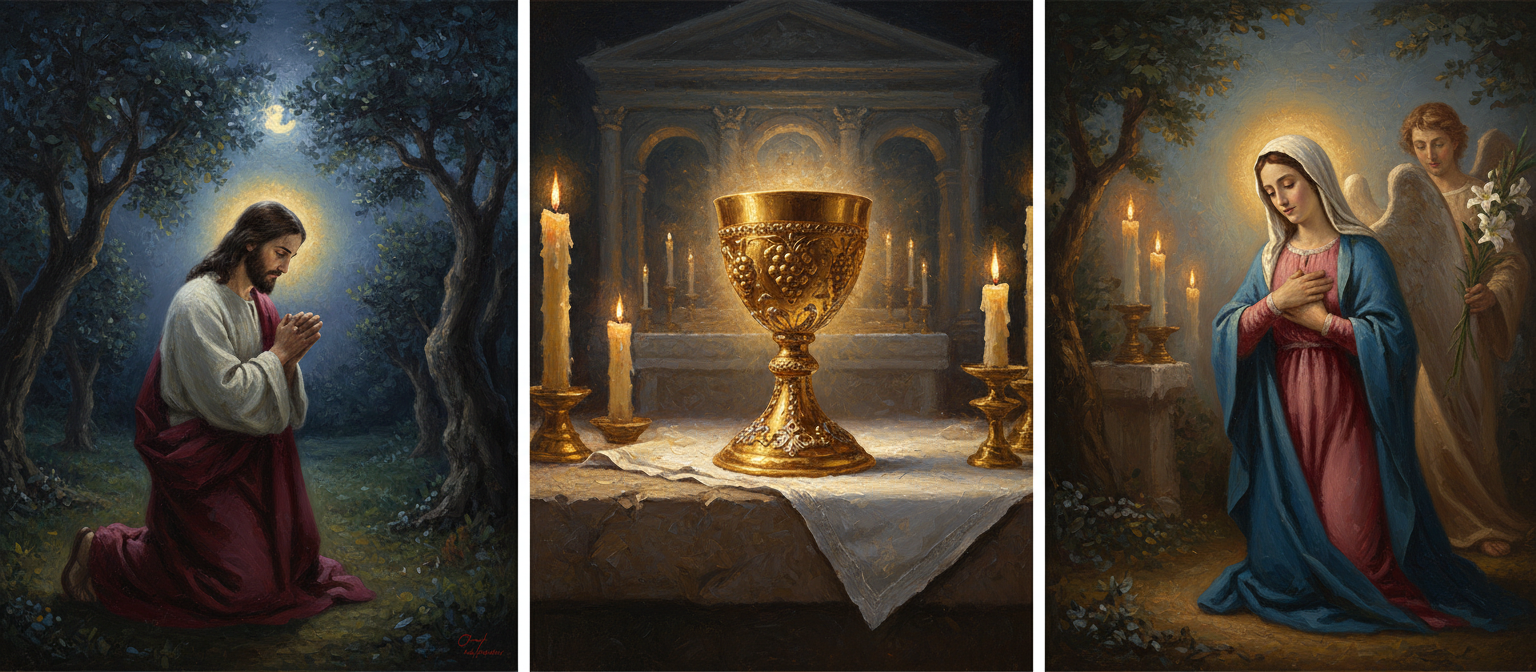
What I see when I stand at the altar
During the Eucharistic Prayer, as the priest raises the sacrifice to the Father, I stand to his right.
It's my proper place. The rubrics say so. But I've come to believe there's something deeper happening in that positioning - something theologically rich that I ponder almost every time I'm at the altar.
The priest acts in persona Christi capitis - in the person of Christ the Head. He stands at the altar as Christ offering the sacrifice to the Father.
The deacon is ordained differently. We act in persona Christi servi - in the person of Christ the Servant. Archbishop José Gomez of Los Angeles put it this way: "A deacon is called to minister in persona Christi Servi—in the person of Christ the Servant. Ordination configures him to Jesus in his most humble form—as the Son of God who emptied himself to come among us in the form of a servant; as the Son of Man who came not to be served, but to serve."
Two dimensions of the one Christ. The Head who offers. The Servant who surrenders.
And there we stand, side by side, at the altar.
Now consider where I'm standing.
The Son - the Servant who emptied himself - now sits at the right hand of the Father in glory. And at the altar, the deacon stands at the right hand of the celebrant.
This isn't liturgical accident. It's theology made visible.
As the priest raises the sacrifice, the one ordained to represent Christ the Servant stands precisely where Christ the Servant now dwells - at the right hand of the one offering to the Father.
Pope Benedict XVI, in an address to the permanent deacons of Rome, reflected on the Pauline hymn in Philippians: Christ "emptied himself, taking the form of a servant." Benedict emphasized that deacons are called to this same kenosis - this self-emptying. The deacon's life, he said, must become configured to Christ's life as servant. The celebration of the sacred liturgy is the foundation for the vocation and ministry of the deacon.
The positioning at the altar embodies this. We assist, but we don't stand there merely as assistants. We stand there as icons of the Servant-Son at the Father's right hand.
And if you follow the chain one step further, there's a Marian dimension I can't escape.
The Church teaches that Mary, the Queen, sits at the right hand of her Son in heaven. The handmaid of the Lord. The one who said, "Let it be done to me according to your word."
The deacon at the right hand of the priest. Christ at the right hand of the Father. Mary at the right hand of Christ.
Servant. Servant. Handmaid.
The positioning echoes through heaven and onto the altar. The one who surrenders, always at the right hand of the one to whom they surrender.
But here's what strikes me most deeply: the chalice.
The deacon is the proper minister of the chalice - the Precious Blood. This isn't merely a practical assignment. It's theological.
Because it was Christ the Servant - not Christ the Head, not Christ the King - who knelt in the Garden of Gethsemane and prayed:
"Father, if it be possible, let this cup pass from me; yet not my will, but yours be done."
The cup. The chalice. The surrender.
The one who took up that cup, who drank it to the dregs, who said yes to the Father's will even unto death - that's the Christ to whom the deacon is configured. And so the chalice is proper to the deacon. It's his because of who he represents.
St. Ambrose preserved a tradition about the deacon Lawrence and Pope Sixtus II. As Sixtus was being led to martyrdom, Lawrence followed him weeping and cried out: "Father, where are you going without your son? Where are you hastening, O priest, without your deacon? Never before did you offer the holy Sacrifice without your minister... So far you have been trusting me with distributing the Blood of the Lord."
Distributing the Blood of the Lord.
Lawrence knew. The chalice was his. The cup of Christ's blood, the cup of Christ's surrender, belonged to the one ordained as servant.
When I stand at the altar now, nearing five years after my ordination, I see all of this.
I see the priest, acting as Christ the Head, offering the sacrifice.
I see myself at his right hand - not as helper, but as icon. The Servant-Son at the right hand of the one offering to the Father.
I see the echo of Mary's yes in my positioning. The handmaid. The servant. Always at the right hand.
And when I hold the chalice, I hold the cup of Gethsemane. The cup Christ the Servant accepted. The cup that sealed his surrender.
Not my will, but yours be done.
This is what ordination did. It configured me to the One who took up the cup. It placed me at the right hand. It made me, in some mysterious way, an icon of the Servant who said yes.
Every Mass, I have the privilege of standing there. Every Mass, I have the privilege of holding that chalice.
And every Mass, I'm invited to make his yes my own.
If this resonated with you, I'd be honored if you shared it with someone who might need to hear it.
Comments
Sign in to leave a comment.