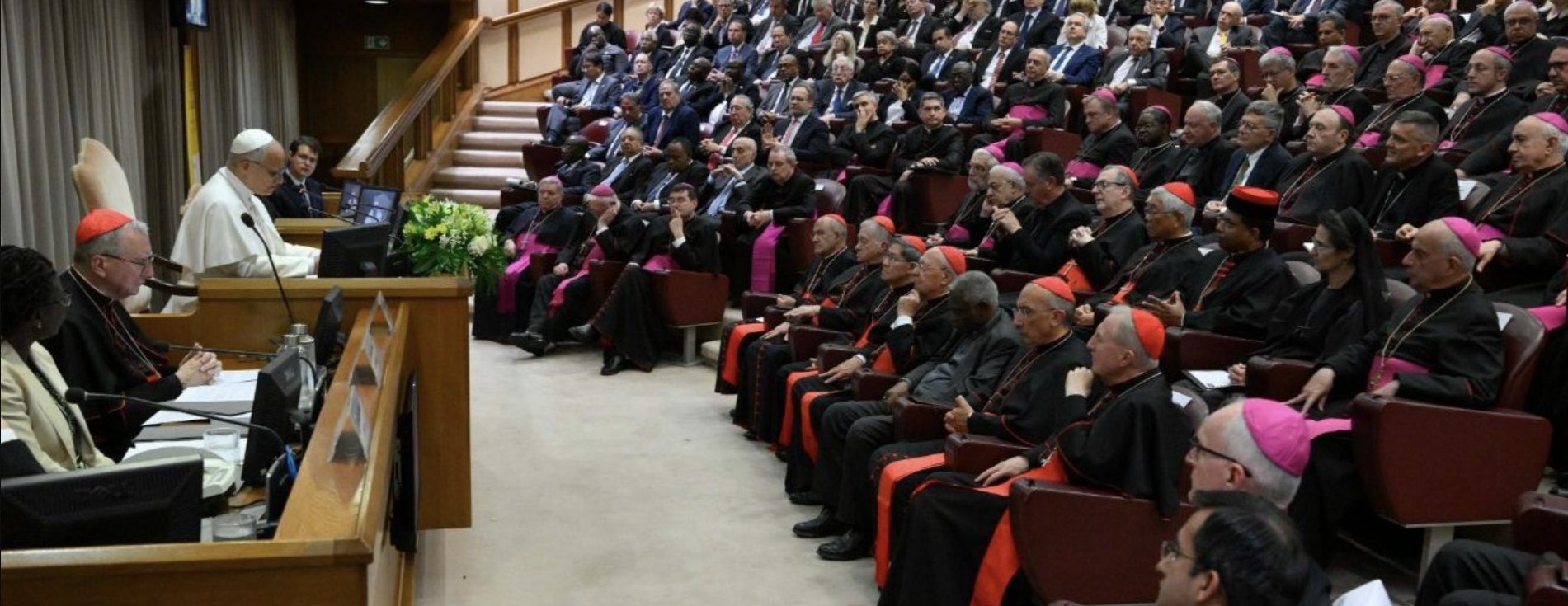
Photo of Pope Leo XIV at the Synod Hall podium, May 25, 2026, presenting Magnifica Humanitas. Credit: Vatican Media.
Pope Leo XIV's first encyclical dropped today, and I couldn't wait to read it.
Magnifica Humanitas: On the Protection of Human Dignity in the Age of Artificial Intelligence is addressed to the whole Church - and to "all men and women of goodwill," believer and unbeliever alike. The Pope wants everyone in on this conversation.
For those unfamiliar: an encyclical is a circular letter from the Pope, meant to be passed around, read aloud, shared from community to community. It's authoritative teaching that calls for what theologians term religious assent of intellect and will - real and sincere docility of mind and heart. It's the principal instrument a pope uses to read "the signs of the times" and interpret them in the light of the Gospel.
And there's something significant in the timing. Pope Leo chose his name deliberately, reaching back to Leo XIII - the pope who in 1891 wrote Rerum Novarum ("Of New Things") and launched the entire tradition we now call Catholic social teaching. Leo XIII was responding to the upheavals of the Industrial Revolution: the factory, the worker, the wage, the collision of capital and labor. Magnifica Humanitas was signed on May 15th - the 135th anniversary of Rerum Novarum - and released today. The message is unmistakable. The first Leo met the machine age of the nineteenth century. This Leo means to meet the machine age of the twenty-first.
I've spent 30 years in media, marketing, and technology - including eighteen years in Big Tech. I've thought about where technology is taking us for a long time. And I'm also a deacon - I preach, visit the sick, serve those in need, and kneel and pray at the wounded edges of life. These two halves of my experience almost never get addressed in the same breath.
This encyclical holds both of them at once.
The Question
Pope Leo doesn't start by asking whether AI is good or bad. He asks something more basic:
What are we building?
That's a builder's question. And he answers it with two images from Scripture, set side by side.
The Tower of Babel. A people with one language, one technology, one direction. They want to build a tower "with its top in the heavens" and "make a name" for themselves. It's impressive. It's also conceived entirely without reference to God - prizing uniformity over communion, efficiency over the human person. The result isn't unity. It's confusion and dispersion. Leo calls this the "Babel syndrome": idolizing profit, flattening difference, pretending that a single language - even a digital one - can translate everything, including the mystery of a human being, into data and performance.
Nehemiah rebuilding the walls of Jerusalem. After the exile, the holy city lies in ruins. Nehemiah hears about it and weeps. But notice what he does first: he fasts, prays, intercedes. Then he surveys the ruins quietly. And then - this is the part that gets me - he convenes the families and assigns each of them a section of the wall to rebuild. Men and women, priests and artisans, heads of households and young people. Each given a stretch of wall. Each contributing what only they can. It's an undertaking with God at the center, and Leo says something beautiful about it: it rebuilds relationships before it rebuilds with stones.
The Pope puts it plainly:
"This is the blessing we implore from God and the task before us: to be builders of communion, not architects of Babel; servants of the coming Kingdom, not owners of towers destined to collapse." (MH, 16)
So there's the choice. Not technology or no technology. Technology isn't the enemy - it's "a profoundly human reality," capable of healing and connecting and protecting.
The choice is between two ways of building. Babel or Jerusalem. A power that wants to dominate the heavens, or a people who labor together in the presence of God to rebuild the walls of a shared life.
What Struck Me
The encyclical is genuinely vast - 245 paragraphs across five chapters, with over 240 footnotes drawing from the whole tradition of Catholic social teaching. It covers the nature of AI systems, transhumanism, disinformation, the attention economy, labor, war, and what Paul VI called the civilization of love. I can't summarize all of it here.
But five things landed for me personally:
First: These systems only imitate intelligence.
Leo is clear about this. AI has no body, no lived experience, no conscience. It doesn't feel joy or pain. It can't mature through relationship. It can't love. It can't bear responsibility for what it does. It can simulate empathy convincingly - but a simulated word doesn't build a real relationship, only its appearance.
As Leo writes:
"No computational system, however sophisticated, can create a heart that gives itself, or a conscience that discerns good from evil. Even when machines excel in efficiency, a human face that asks to be gazed upon remains the center of our history." (MH, 233)
I've used these tools. I use them now. But I've never forgotten that they're imitation, not the real thing. The Pope is naming something the industry doesn't want to name.
Second: The technocratic paradigm.
Drawing on Pope Francis and the philosopher Romano Guardini, Leo describes what he calls the technocratic paradigm - the slow, almost invisible takeover of our thinking by the logic of efficiency, control, and profit. Technology stops being a tool and becomes the standard by which everything is judged. People start to be measured by their output. "Having more" quietly replaces "being more."
Guardini's line, which Leo quotes, lands like a verdict on the industry I came from: contemporary man "has not been trained to use power well."
That was the tension I felt for years at Adobe. I was good at building powerful things. I was far less sure we had been trained to use that power well - or that anyone was asking the question.
The conviction that grew in me, prayerfully and slowly, was that I wanted to build things that form people rather than harvest them. That's why Domus exists. That's why I left.
Reading this chapter, I felt less like a man receiving a warning from outside and more like a man hearing his own conscience read back to him by the Holy Father.
Third: The universal destination of goods - including data.
The Church has always taught that the goods of the earth are given by God for everyone, and that private property is always subordinate to that universal purpose. What Leo does is extend that principle into the digital age explicitly. Among the goods now universally destined for all, he says, we must include patents, algorithms, digital platforms, technological infrastructure, and data.
He calls data a kind of common good - something produced by many contributors that "cannot be left solely in private hands."
I sat with that. Years ago I made a deliberate choice to own my own infrastructure rather than rent everything from the big platforms. At the time it felt like a technical preference, maybe a stubborn one. Reading Leo, I understand it differently now. Building close to the ground - intermediary, accountable, near the families and the parish you actually serve - is itself a small act of resistance against the concentration of power he's warning about.
Fourth: Subsidiarity needs solidarity, and solidarity needs subsidiarity.
These are two of the great principles of Catholic social teaching. Subsidiarity says decisions should be made at the most local level capable of making them. Solidarity is the firm commitment to the good of all, especially the most vulnerable.
What Leo insists on - and what I'd never seen stated so sharply - is that the two can't be separated. Subsidiarity without solidarity curdles into mere protection of private interest. Solidarity without subsidiarity decays into managed dependency that doesn't foster real responsibility. They hold each other up.
That balance is exactly what the parish work aims at. It's what Ad Alta aims at. Good leadership hands responsibility down and out; it doesn't hoard it at the top.
Fifth: Remaining human is the whole point.
If I had to carry one sentence of this encyclical into every hospital room and every graveside and every time a person asks me about their failures or their sufferings, it would come from this part of the letter.
"Such systems do not know compassion, mercy, forgiveness, and above all, the hope that people are able to change." (MH 102)
Leo confronts the deepest lie of the transhumanist dream - the idea that our limits, our weakness, our illness and aging and suffering, are simply defects to be corrected. And he answers that humanity flourishes not despite its limits but very often through them. It's precisely in our vulnerability that compassion is born, that generosity emerges in the dark, that we discover the closeness of others and the presence of the Lord.
He draws a contrast I find unforgettable. For an algorithm, an error is simply a flaw to be corrected. For a person, an error can be the beginning of conversion. A machine can't understand that. It can't comprehend the catalyst hidden inside a failure, the future that depends on freedom and grace and the relationships we cultivate.
This is the anthropological center of the whole document. And it's the thing a deacon exists to defend.
I was ordained precisely to kneel at the wounded edges of life - the places the technocratic paradigm would rather optimize out of existence. And the truth I'm there to witness is the one Leo states plainly: no machine can ever replace the human heart as the place where God desires to dwell.
Your Section of the Wall
The Pope didn't write this for builders of websites. He wrote it for everyone - because everyone is building something. A marriage, a family, a friendship, a parish, a life.
And you're doing it, more and more, with powerful tools in your hands. The phone on the kitchen table. The assistant that answers your questions. The feed that shapes what you think about all day.
So here's Leo's question, made personal:
Am I building Babel, or am I rebuilding Jerusalem?
Am I reaching for a name, an efficiency, a control that quietly pushes God and my neighbor to the margins? Or am I taking up my own section of the wall, working in the presence of God, rebuilding relationships before I rebuild anything else?
Leo writes:
"The civilization of love will not arise from a single or spectacular gesture, but from the sum total of small and steadfast acts of fidelity that serve as a bulwark against dehumanization." (MH, 213)
Small and steadfast acts of fidelity. That's the work.
And I realize: I have been given my own section of the wall.
Domus. Ad Alta. The parish work. The homilies. The daily Scripture reflections that go out to families every morning. These are my stretch of stones. This is what I've been asked to tend - not the whole wall, not someone else's section, but this one. Mine. Ours.
That's the freedom Nehemiah's model offers. You don't have to rebuild the whole city. You just have to show up for your section, day after day, with the people God has given you, in the presence of the God who holds it all.
The encyclical doesn't end with a warning. It ends with the Magnificat - with Mary, whose soul proclaims the greatness not of herself but of the Lord. A humanity made grand not by its own reach but by grace received.
That's what Magnifica Humanitas finally means. The grandeur of humanity is real, and it's a gift, and no machine can replace it or surpass it.
We just have to stop trying to build the tower - and pick up our trowels for the wall instead.
NOTE: If you're interested in a deeper, more theological analysis of the encyclical, you can read what I write for Missio Dei this morning here.
Comments
Sign in to leave a comment.