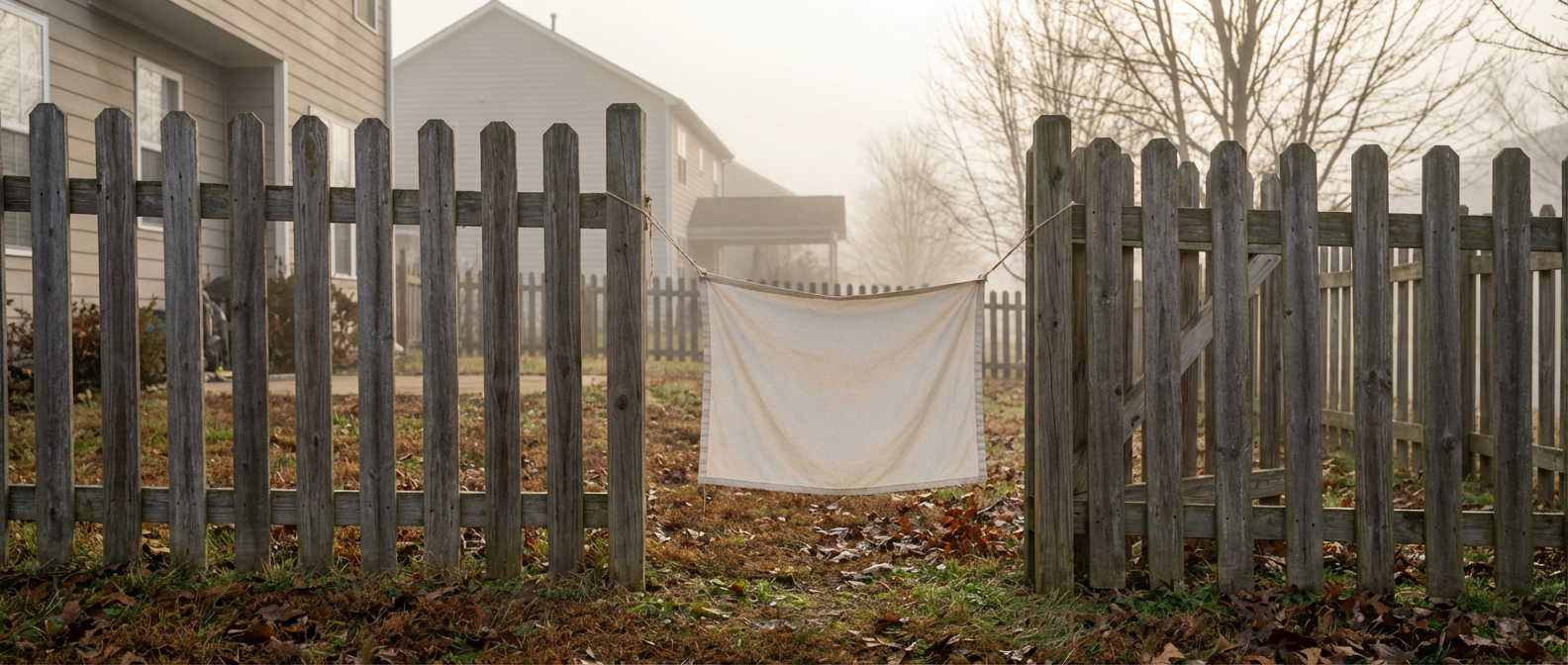
I was driving through Springfield last week when I passed a house with a homemade banner stretched along the fence. Hand-painted letters, simple and direct:
"When did we lose our humanity?"
I don't know who made it. I don't know what prompted it - maybe the news, maybe something closer to home. But the question stayed with me for miles, and it hasn't left yet.
When did we lose our humanity?
It's a question that feels increasingly urgent. We watch the headlines and wonder how people can do what they do to one another. We scroll through comments sections and wonder when discourse became blood sport. We see neighbors turn on neighbors, families fracture over politics, strangers dehumanize strangers with a casualness that should alarm us more than it does.
Something is broken. The banner got that right.
But the answer to the question is older than any of us realize.
We lost our humanity in a garden.
Not entirely - we are still human, still bearing the image of God, still capable of extraordinary goodness. But something cracked at the foundation. The Church calls it Original Sin, and it is not merely a doctrine to be believed but a wound to be reckoned with.
In the Garden of Eden, our first parents were offered a lie: that they could become like gods on their own terms, that they could define good and evil for themselves, that they did not need to receive their identity and purpose as gift. They believed the lie. And in that moment, something in humanity fractured.
The fracture did not make us less than human. It made us less than we were meant to be. We became capable of using one another instead of loving one another, of seeing others as obstacles or instruments rather than as brothers and sisters. We became curved in on ourselves - incurvatus in se, as Augustine put it - bent toward our own will, our own appetites, our own sovereignty.
Every headline that makes you ask "how could someone do that?" is an echo of that original fracture. Every cruelty, every indifference, every quiet sin of omission flows from the same source. We did not lose our humanity in 2020 or 1968 or 1914. We lost it in Eden. Everything since has been downstream.
But the story does not end in the garden.
This is what the Church proclaims most clearly during Holy Week: the fracture is not the final word. What was lost in a garden is restored through a tree - not the tree of the knowledge of good and evil, but the wood of the Cross.
The Paschal Mystery - Christ's passion, death, and resurrection - is God's answer to the banner on the fence. When did we lose our humanity? In Eden. How do we get it back? Through the One who took on our humanity in order to heal it from the inside.
This is not abstraction. It is not theology disconnected from life. It is the lived reality that the Church enters into this very week.
On Holy Thursday, we watch Jesus kneel and wash the feet of his disciples - the inversion of everything the world calls power, the restoration of what humanity was always meant to be. We see him take bread and wine and give us his very self, because love is not love until it is given away.
On Good Friday, we stand at the foot of the Cross and see the cost of our fracture - and the depth of God's response. The sin of Eden demanded death. Christ absorbed that death into himself so that it would not have the final word over us.
On Holy Saturday, the Church waits in silence. The tomb is sealed. And in that silence, something is happening that we cannot see: Christ descends to the dead, harrowing hell, reaching back through all of history to reclaim every human being who ever lived and died under the shadow of the fall.
And then, at the Easter Vigil, fire breaks the darkness. The Paschal candle enters the church. The Exsultet is sung. And the Church dares to call Adam's sin felix culpa - the happy fault - because it occasioned so great a Redeemer.
When did we lose our humanity?
The question is real, and the ache behind it is legitimate. Something is broken in us and between us, and no policy or program or platform will fix it, because the fracture is deeper than politics can reach.
But the answer is not despair. The answer is a cross, an empty tomb, and a God who entered into our fractured humanity in order to make us whole.
This is the week the Church tells that story - not as history, but as present reality. The liturgies of Holy Week are not reenactments. They are participation. When we walk through these days, we are walking into the mystery that answers the question on the banner.
We lost our humanity in a garden. We receive it back at the font, at the altar, at the foot of the Cross.
If you have the chance this week, enter in. Holy Thursday. Good Friday. The Easter Vigil. Let the Church's liturgy do what it was designed to do: draw you into the saving work of Christ and restore what was lost.
The banner asked a question. This week, the Church gives the answer.
If this resonated with you, I'd be honored if you shared it with someone who might need to hear it.
Comments
Sign in to leave a comment.